
Search
- 1. Azerbaijan’s International Image-Making Strategies and Challenges
-

Azerbaijan's International Image-Making Strategies and Challenges
EVN Report, 14 January 2025 [Armenian version]
The Azerbaijani state has embarked on a concerted effort to enhance its international image following the Second Karabakh War in 2020 and especially since the subsequent ethnic cleansing of Armenians orchestrated by
2025-01-24 - 2. Geopolitics and Business Development in the Caspian Regi
-
Hratch Tchilingirian and Stacy Closson, “Geopolitics and Business Development in the Caspian Region”. Conference Report, Geopolitics and Business Development in the Caspian Region, 17-18 September 2005. Cambridge: Eurasia Programme, Judge Business School, University of Cambridge, 2005.
2023-07-31 - 3. Perceptions and expectations in Diaspora-Armenia relations
-

Speaker: “’Homeland Diaspora, Motherland Armenia’: perceptions and expectations in Diaspora-Armenia relations.”
Conference on The Impact of Regional Transitions on Armenia: Challenges and Opportunities, organised by Friedrich-Ebert-Stiftung and Institute of Oriental Studies, National Academy of Sciences. Tsagkhadzor, 12 June 2022.
2022-06-10 - 4. New hope for Turkey-Armenia to heal old wounds
-
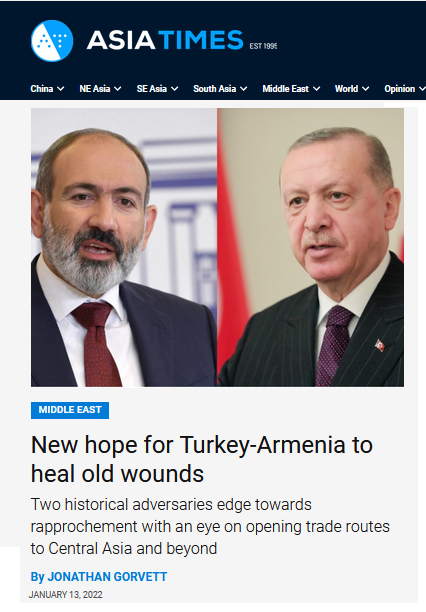
New hope for Turkey-Armenia to heal old wounds
Two historical adversaries edge towards rapprochement with an eye on opening trade routes to Central Asia and beyond
"...Now though, “We’ve come 180 degrees,” Hratch Tchilingirian, from the Faculty of Oriental Studies at Oxford University, told Asia Times, “and there’s a completely different context.”
2022-01-13 - 5. Why It Matters
- ... once boasted an empire that touched the Mediterranean, Caspian and Black Seas; now, its country is about the same size as the US state of Maine. Often cited as the world’s first Christian nation, Armenia ...
- 6. Religion in a Non Religious War
-
"Religion in a Non-Religious War: The Conflict over Nagorno Karabakh"
Hratch Tchilingirian, University of Oxford
Strategic Note on Religion & Diplomacy (Georgetown University), May 2021, pp. 8-10.
The instrumentalization of religion—especially Islam by Azerbaijan in foreign relations—in the nonreligious Nagorno Karabakh conflict could further deepen the differences among the parties in the conflict and in the region, and make a final resolution and reconciliation even more difficult.
2021-05-28 - 7. Biden drops a genocide bomb on Erdogan
-
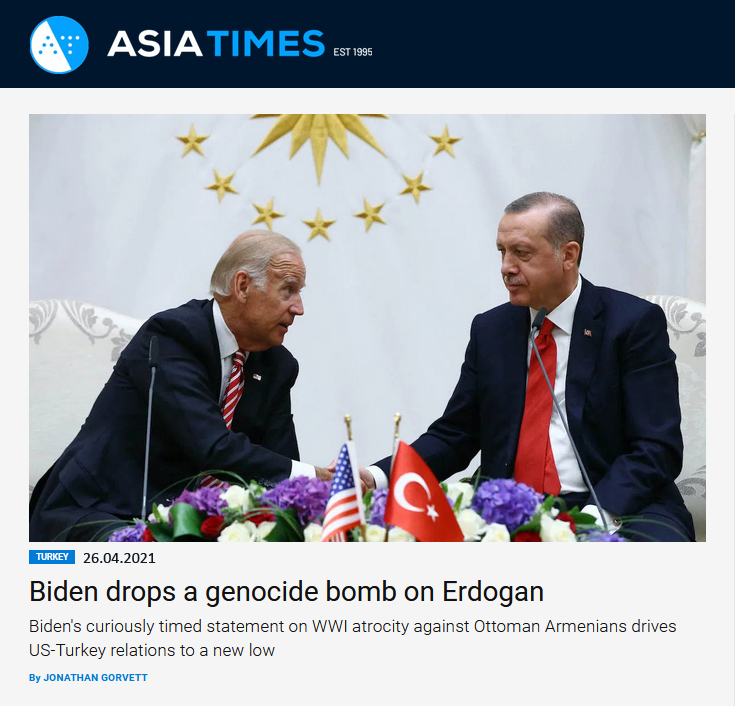
Biden drops a genocide bomb on Erdogan
Biden's curiously timed statement on WWI atrocity against Ottoman Armenians drives US-Turkey relations to a new low. . .“there was no additional strategic risk for the US in doing this,” Hratch Tchilingirian, from Oxford University’s Faculty of Oriental Studies, told Asia Times...
2021-04-27 - 8. Karabağ’da Hristiyanlık
-

Karabağ’da Hristiyanlık: Azerbaycan’ın Tarihi Yeniden Yazma Çabaları Yeni Değil
Hratch Tchilingirian, Oxford Üniversitesi
HyeTert.org, 9.12.2020 - Karabağ’da silahlı çatışma başlamadan çok daha önce, bölgenin gerçek tarihini ‘ispatlama’ çabaları, tarihçiler, siyaset bilimi uzmanları, arkeologlar, araştırmacılar ve bürokratlar için akademik ve bilimsel bir savaş alanıydı. Sovyet araştırma geleneği, özellikle de tarihin inşası süreci, oldukça yıkıcıydı ve hala da çatışan tarafların...2021-03-29 - 9. Nagorno Karabakh, il mistero della chiesa scomparsa
-

Nagorno Karabakh, il mistero della chiesa scomparsa
Dopo la fine del conflitto, continua la preoccupazione degli armeni per la perdita del loro patrimonio culturale
ACI Stampa, 26 marzo 2021, Andrea Gagliarducci
... In questi giorni è stato pubblicato uno studio di Hratch Tchilingirian, che ha messo in luce come, da quando il Nagorno Karabakh è stato assegnato all’Azerbaijan divenuto una repubblica sovietica...
2021-03-26 - 10. Christians in Lebanon and Syria: Critical challenges
-

Lecture: “Christians in Lebanon and Syria: Critical challenges in the context of wider regional military and political conflicts and socio-economic realities”, course on “Ethnic and Religious Minorities in MENA.”
States and Societies Faculty, Diplomatic Academy, FCO, 27 November 2020.
2020-11-27 - 11. Christianity in Karabakh: Azerbaijani Efforts At Rewriting History Are Not New
-
Christianity in Karabakh: Azerbaijani Efforts At Rewriting History Are Not New
Dr. Hratch Tchilingirian, Oxford
EVN Report / MassisPost / Aravot (22 November 2020)—Long before the start of the armed conflict in Karabakh, the “authentication” of the history of the region had become the scholarly battleground of historians, political scientists, archaeologists, researchers and bureaucrats. The consequences of Soviet scholarship—particularly in the process of constructing histories—have been disastrous and continue to have a negative impact on how conflicting parties view “the other.” It should be noted that, even today,
2020-11-24 - 12. Publications & lectures about Nagorno Karabakh
-
Book
Hratch Tchilingirian (2003) The Struggle for Independence in the post-Soviet South Caucasus: Karabakh and Abkhazia. (London: Sandringham House, 2003).
Chapters / journal articles / lectures
Hratch Tchilingirian (2023) “Reverse Engineering: A State-Created ‘Albanian Apostolic Church’” in Caucasian Albania. An International Handbook. Edited by Jost Gippert and Jasmine Dum-Tragut. Berlin, Boston: De Gruyter, 2023: 581-609, https://doi.org/10.1515/9783110794687-019.
Hratch Tchilingirian (2021) "Nagorno-Karabakh: War Fails to Resolve the Conflict", The Cambridge Journal of Law, Politics, and Art (CJLPA), Issue 1, Summer 2021: 398-400.
Hratch Tchilingirian (2021) "Religion in a Non-Religious War: The Conflict over Nagorno Karabakh", Strategic Note on Religion & Diplomacy (Georgetown University), May 2021, pp. 8-10.
Hratch Tchilingirain (2021) "Christians in Karabakh. The rich religious heritage in Artsakh from 4th to 21st century” (lecture video), Diocese of the Armenian Church in the United Kingdom and Ireland, 12 May 2021.
Hratch Tchilingirain (2020), "Crisis in the Caucasus: Nagorno Karabakh" (lecture video). University of St. Andrews La Fayette Club, 9 November 2020.
Hratch Tchilingirain (2020) "Christianity in Karabakh: Azerbaijani Efforts At Rewriting History Are Not New", EVN Report, 22 November.
Hratch Tchilingirian (2020) "Karabağ’da Hristiyanlık: Azerbaycan’ın Tarihi Yeniden Yazma Çabaları Yeni Değil", HyeTert.org, 9 December 2020.
Hratch Tchilingirian (2018) [Christianity in] “Armenia and Karabkah” in Christianity in North Africa and West Asia (edited by Kenneth R. Ross, Mariz Tadros, Todd M. Johnson). Edinburgh Companions to Global Christianity 2. Edinburgh: Edinburgh University Press. 198-201.
Hratch Tchilingirian (2005) “New Structures, Old Foundations. State Capacities for Peace”, Accord. An International Review of Peace Initiatives. Issue 17.
Hratch Tchilingirian (1999) “Nagorno Karabagh: transition and the elite”, Central Asian Survey, 18(4).
Hratch Tchilingirian (1998) “Le conflit du Haut-Karabagh provoque des changements majeurs en Arménie”, Nouveaux Mondes, No. 8, Été. Centre de Recherches Entreprises et Sociétés, Geneva.
Hratch Tchilingirian (1997) “Religious Discourse and the Church in Mountainous Karabakh 1988-1995”, Revue du monde arménien moderne et contemporain (Paris) 3.
Articles
Hratch Tchilingirian (2000) “Psychological Welfare. Healing the Emotional Scars of the Karabakh War”, Armenian International Magazine, January. “Savaş çocuklarının gȍzüyle”, Agos, 19 Ocak.
Hratch Tchilingirian (1999) “The Istanbul Summit: Fifty-Four Nations Discuss Regional Security and Conflicts”, Armenian International Magazine, December.
Hratch Tchilingirian (1999) “Back In Karabakh. Diocese of Artsakh Celebrates 10th Anniversary of Re-establishment”, Armenian International Magazine, October.
Hratch Tchilingirian (1999) “From Activism to Diplomacy. Karabakh finds a place in the geostrategic architecture of the Caucasus”, Armenian International Magazine, April.
Hratch Tchilingirian (1999) “Berg-Karabach: Die Außenpolitik im Wandel”, Armenisch-Deutsche Korrespondenz (ADK), No. 103, Heft 1; No. 104, 1999, Heft 2.
Hratch Tchilingirian (1998) “Aliyev Invites Kocharian. Global Strategies Shape Regional Developments”, Groong: Review & Outlook, August 14.
Hratch Tchilingirian (1998) “Current Social, Economic and Political Situation in Nagorno Karabakh. Interview with Karen Ohanjanian”, ANN/Groong, March 31.
Hratch Tchilingirian (1998) “Political Crisis in Armenia. Armenia faces its first major post-Soviet leadership change”, Groong: Review & Outlook. February 6.
Hratch Tchilingirian (1997) “Nagorno Karabakh: A Time for Thoughtfulness?”, War Report, No. 56, November.
Hratch Tchilingirian (1995) “Karabakh: Edging Towards the Big Agreement”, War Report, No. 34, June.
Hratch Tchilingirian (1997) “Karabakh: Internationalising the Enclave”, War Report, No. 50, April.
Hratch Tchilingirian (1997) “Armenia: Rebooting the Political Hard Drive”, War Report, No. 50, April.
Hratch Tchilingirian (1996) “Armenia/Azerbaijan: Nagorno-Karabakh Impasse”, Oxford Analytica, December 6.
Hratch Tchilingirian (1996) “On Campus in Karabakh”, Armenian International Magazine, April.
Hratch Tchilingirian (1995) "Interview with Emma Gabrielyan, Secretary of the Parliament of Mountainous Karabakh", Nairi (Beirut), 4 November.
2020-11-14 - 13. Hratch Tchilingirian (short bio)
-
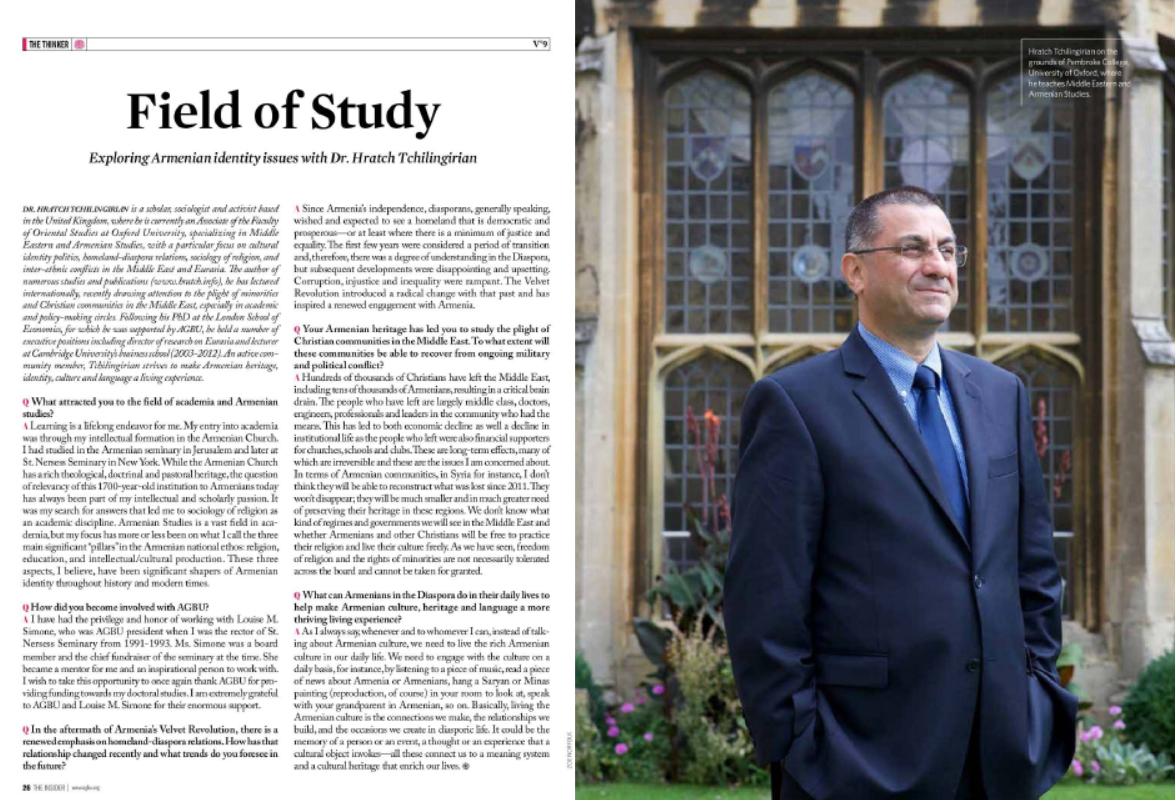 2019-01-02
 - 14. A decade-long goodbye for a journey cut short
-
Published in



A decade-long goodbye for a journey cut short
In Memoriam: Patriarch Mesrob Mutafyan (1956-2019)
Hratch Tchilingirian | CivilNet.am 10 March 2019
Patriarch Mesrob Mutafyan was one of the most courageous, principled and forward looking church leaders in the contemporary history of the Armenian Church. His youth, charisma, strong pastoral and
2019-03-11 - 15. Field of Study
-
2019-01-02
- 16. First Republic Conference, Los Angeles
-
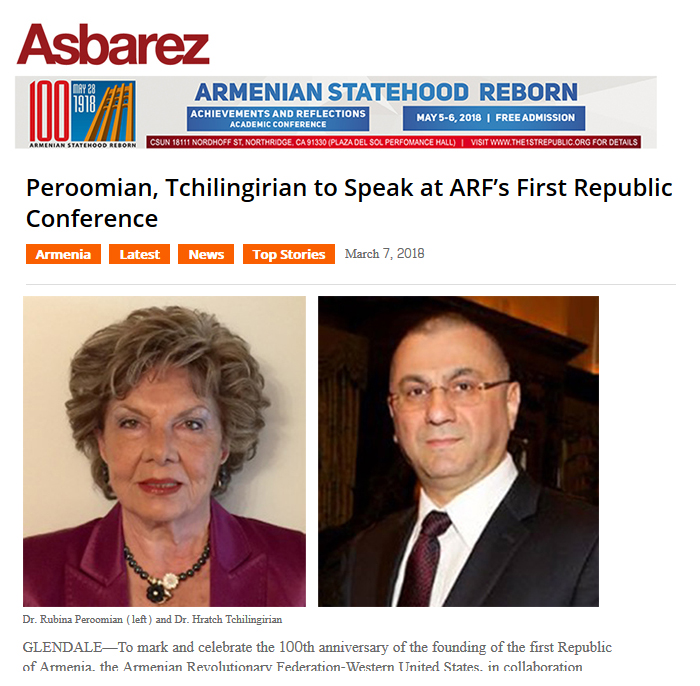
Peroomian, Tchilingirian to Speak at ARF’s First Republic Conference
Glendale (Asbarez, March 7, 2018)—To mark and celebrate the 100th anniversary of the founding of the first Republic of Armenia, the Armenian Revolutionary Federation-Western United States, in collaboration with the California State University, Northridge Armenian Studies Program, has organized a two-day academic conference, “Armenian Statehood Reborn: Achievements and Reflections.”… Two of the acclaimed speakers at the conference will be Dr. Hratch Tchilingirian and Dr. Rubina Peroomian...
2018-03-12 - 17. Il catholicosato di Aghuank (o Gandzasar)
-
Il catholicosato di Aghuank (o Gandzasar)
Hratch Tchilingirian (a Storia religiosa dell’Armenia, 2010)
Nel IV secolo, poco dopo la conversione dell’Armenia al cristianesimo, il Regno di Albania (da non confondersi con l’Albania dei Balcani) che comprendeva le province di Artsakh (la futura Karabagh) e Utik, si convertì al cristianesimo grazie agli sforzi di Gregorio l’Illuminatore, evangelizzatore dell’Armenia. Grigoris, il nipote di san Gregorio, fu nominato capo della Chiesa albanese intorno al 330 d.C. Fu martirizzato nel 338 mentre evangelizzava la regione a nordest del paese, nei pressi di Derbend (l’attuale Daghestan). Il suo corpo fu traslato in Artsakh e sepolto in una
2018-02-24 - 18. The 'Other' Citizens: Armenians in Turkey
-

Lecture: “The ‘Other’ Citizens – Armenians in Turkey between Isolation and (dis)Integration”, American University of Armenia (AUA), Political Science & International Affairs (PSIA).
2017-03-29 - 19. Lecture: Christianity in Middle East
-

Lecture: “Christian Communities in the midst of extremism, regional military conflicts and wars in the Middle East”
20 October 2015, The Oriental Institute, University of Oxford
 Programme2015-11-28
 - 20. Participant: Azerbaijani Perspectives on the Nagorno-Karabakh Conflict
-
Chatham House, Russia and Eurasia Programme
Invited participant: “Azerbaijani Perspectives on the Nagorno-Karabakh Conflict” with Rovshan Rzayev, Member of Azerbaijani Parliament and Executive Board Member of the Azerbaijani Community of the Nagorno Karabakh Region, and Kavus Abushov, Assistant Professor of Political Science, ADA University, Baku.
29 September 2015, The Royal Institute of International Affairs, London.
2015-09-29