Search
- 1. Religious Pluralism in the Modern Middle East
-

Paper: "Minority within Minorities: Armenian communities in the Middle East between imposed realities and uncertain future", CME International Workshop, Athens, Greece, 21 October 2022. Christianity and Religious Pluralism in the Modern Middle East: International Politics and Religion at the turn of the 20th and 21st century, funded by the Hellenic Foundation for Research and Innovation
2025-02-05 - 2. Azerbaijan’s International Image-Making Strategies and Challenges
-

Azerbaijan's International Image-Making Strategies and Challenges
EVN Report, 14 January 2025 [Armenian version]
The Azerbaijani state has embarked on a concerted effort to enhance its international image following the Second Karabakh War in 2020 and especially since the subsequent ethnic cleansing of Armenians orchestrated by
2025-01-24 - 3. Dr. Hratch Tchilingirian Appointed Director of Institutional Innovation
-
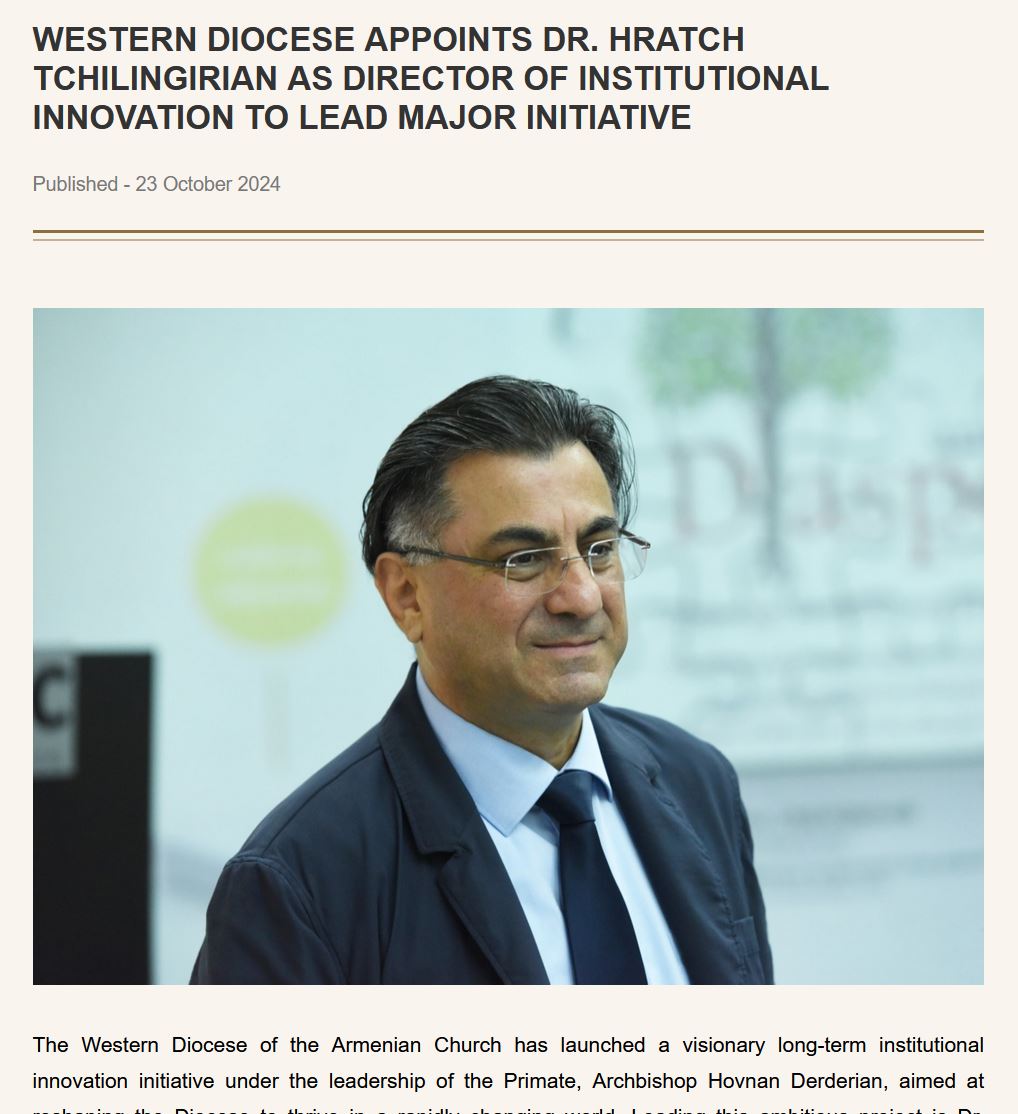
Western Diocese Appoints Dr. Hratch Tchilingirian as Director of Institutional Innovation to Lead Major Initiative
Massis Post, 24 October 2024 | Asbsarez, 24 October 2024
 2024-12-02
 - 4. What is *Armenian* in Armenian Identity
-
 Hratch Tchilingirian (2021) "What is 'Armenian' in Armenian Identity?" in Altuğ Yılmaz (ed.) Critical Approaches to Armenian Identity in the 21st Century: Vulnerability, Resilience and Transformation. Istanbul: Hrant Dink Foundation. pp. 31-40.2024-07-13
 - 5. Being Armenian is a package
-
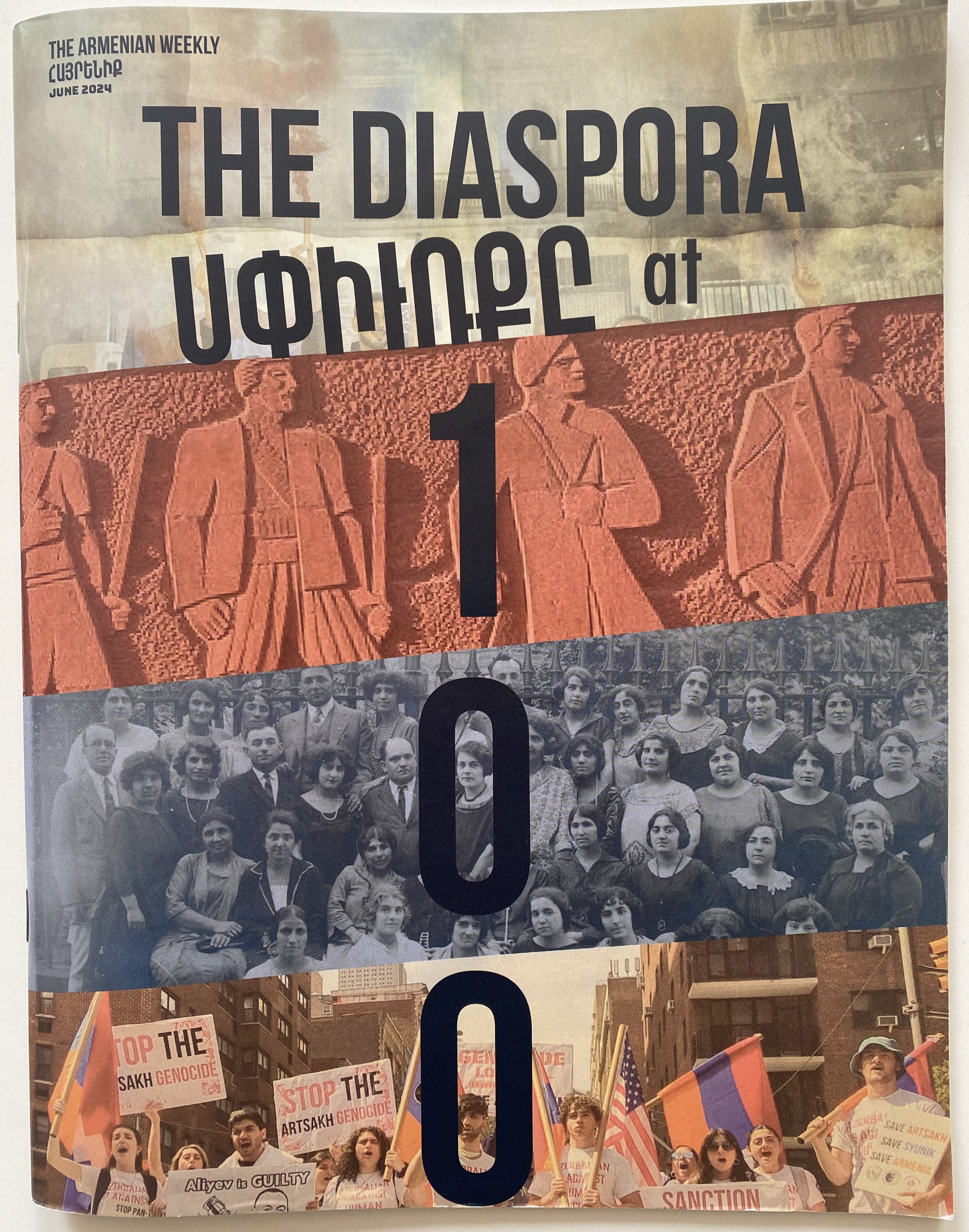
Hratch Tchilingirian, “’Being Armenian is a package.’ Some critical issues facing Diaspora organizations today,” in H. Oshagan and Kh. Tölölyan (eds.), The Diaspora at 100. (Boston: The Armenian Weekly), June 2024: 60-61.
2024-07-18 - 6. Ethnic Cleansing: Does International Law Still Matter?
- ... in London on March 19th. In setting the larger context of the annual lecture, Dr Hratch Tchilingirian, in his opening remarks as chair of the proceedings, said: “We are here tonight because “‘Never ...
- 7. Tölölyan Honored as Preeminent Scholar of Diaspora Studies
-
 Tölölyan Honored as Preeminent Scholar of Diaspora StudiesCynthia Rockwel l The Wesleyan Connection, November 12, 2019... Director of the ADS, Hratch Tchilingirian, associate of the Faculty of Oriental Studies at Oxford University, thanked Tölölyan for his service on the project, noting “In addition to his brilliant scholarship and numerous academic accolades, Khachig Tölölyan is a wonderful human being. He shares his enormous, accumulated wisdom with intellectual humility; engages with everyone with grace and empathy; and empowers others with generous and sincere acknowledgment and encouragement.”2024-03-07
 - 8. Karabakh: The rich religious heritage in Artsakh from 4th to 21st century”
-
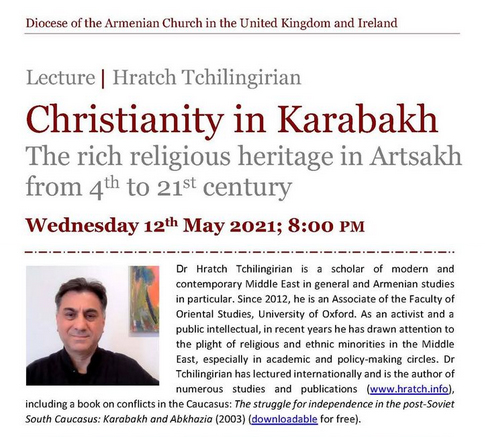
Lecture: "Christians in Karabakh. The rich religious heritage in Artsakh from 4th to 21st century”
Diocese of the Armenian Church in the United Kingdom and Ireland, 12 May 2021.
(video)
2021-08-27 - 9. The rich religious heritage in Artsakh from 4th to 21st century
-
Lecture: "Christians in Karabakh. The rich religious heritage in Artsakh from 4th to 21st century”
Diocese of the Armenian Church in the United Kingdom and Ireland, 12 May 2021.
(video)
2021-08-27 - 10. What is the Armenian Diaspora Survey?
-

Armenian Institute (London), Zanazan podcast, 3 June 2021
This podcast explores the people behind the Armenian Diaspora Survey. Hosted by this year’s UK qualitative researcher and AI Academic Advisor, Dr. Susan Pattie speaks with ADS Director Dr. Hratch Tchilingirian (at 4:04 minutes) and a number of team members from around the world, including qualitative researchers Dr. Lalai Manjikian in Montreal and Lucila Tossounian in Buenos Aires, and Boston team leader Dr. Pamela Young. We learn how and why ADS exists, who benefits from it, and where to find out more.
2021-07-05 - 11. La diaspora passée au crible
-
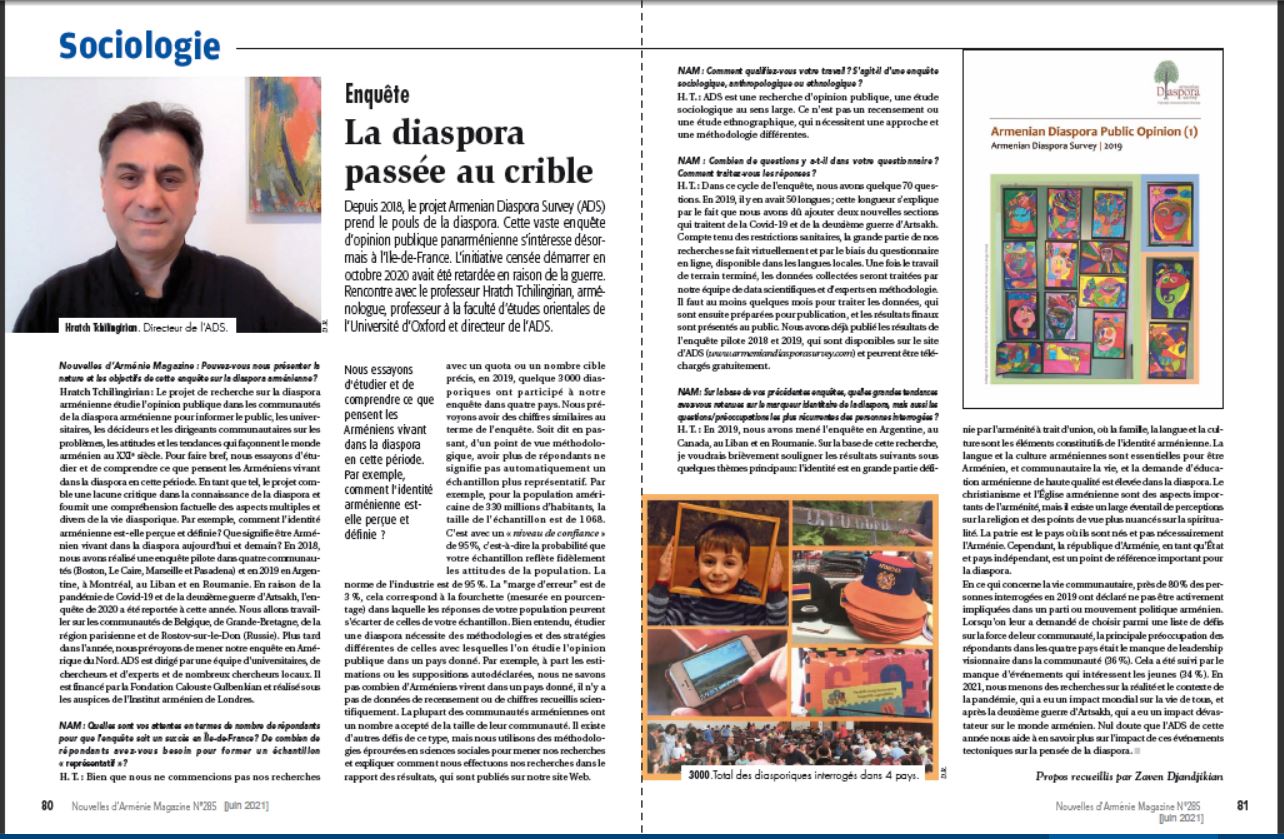
Nouvelles d’Arménie Magazine N°285, juin 2021
Sociologie: La diaspora passée au crible
Depuis 2018, le projet Armenian Diaspora Survey (ADS) prend le pouls de la diaspora. Cette vaste enquête d’opinion publique panarménienne s’intéresse désormais à l’Ile-de-France. L’initiative censée démarrer en octobre 2020 avait été retardée en raison de la guerre. Rencontre avec le professeur Hratch Tchilingirian, arménologue, professeur à la faculté d’études orientales de l’Université d’Oxford et directeur de l’ADS.
2021-06-28 - 12. 'Entering into the womb of the earth'
-

Keynote speaker: "'Entering into the womb of the earth': A theological reflection on the Covid-19 pandemic, on death and life."
The ReClaim annual conference, Western Diocese of the Armenian Church, Los Angeles, 6 March 2021.
2021-03-29 - 13. Karabağ’da Hristiyanlık
-

Karabağ’da Hristiyanlık: Azerbaycan’ın Tarihi Yeniden Yazma Çabaları Yeni Değil
Hratch Tchilingirian, Oxford Üniversitesi
HyeTert.org, 9.12.2020 - Karabağ’da silahlı çatışma başlamadan çok daha önce, bölgenin gerçek tarihini ‘ispatlama’ çabaları, tarihçiler, siyaset bilimi uzmanları, arkeologlar, araştırmacılar ve bürokratlar için akademik ve bilimsel bir savaş alanıydı. Sovyet araştırma geleneği, özellikle de tarihin inşası süreci, oldukça yıkıcıydı ve hala da çatışan tarafların...2021-03-29 - 14. Christianity in Karabakh: Azerbaijani Efforts At Rewriting History Are Not New
- ... is a matter of academic debate, most scholars agree that Azerbaijan, as a national entity, emerged after 1918.[2] The debate on what to name the Azerbaijanis goes back to the late 19th century; the population ...
- 15. We have outlived empires and can build our nation's tomorrow
-


We have outlived empires and can build our nation's tomorrow
CivilNet / HyeTert / Massis Post 11 November 2020
Hratch Tchilingirian, Oxford
As one of the nations in this world, whose millennia-long biography is the envy of the world, we should not allow some anomalous, self-interested forces, circles or personalities trample the national wisdom we have gained through myriads of imposed wars, destruction and displacement.
2020-11-24 - 16. Publications & lectures about Nagorno Karabakh
-
Book
Hratch Tchilingirian (2003) The Struggle for Independence in the post-Soviet South Caucasus: Karabakh and Abkhazia. (London: Sandringham House, 2003).
Chapters / journal articles / lectures
Hratch Tchilingirian (2023) “Reverse Engineering: A State-Created ‘Albanian Apostolic Church’” in Caucasian Albania. An International Handbook. Edited by Jost Gippert and Jasmine Dum-Tragut. Berlin, Boston: De Gruyter, 2023: 581-609, https://doi.org/10.1515/9783110794687-019.
Hratch Tchilingirian (2021) "Nagorno-Karabakh: War Fails to Resolve the Conflict", The Cambridge Journal of Law, Politics, and Art (CJLPA), Issue 1, Summer 2021: 398-400.
Hratch Tchilingirian (2021) "Religion in a Non-Religious War: The Conflict over Nagorno Karabakh", Strategic Note on Religion & Diplomacy (Georgetown University), May 2021, pp. 8-10.
Hratch Tchilingirain (2021) "Christians in Karabakh. The rich religious heritage in Artsakh from 4th to 21st century” (lecture video), Diocese of the Armenian Church in the United Kingdom and Ireland, 12 May 2021.
Hratch Tchilingirain (2020), "Crisis in the Caucasus: Nagorno Karabakh" (lecture video). University of St. Andrews La Fayette Club, 9 November 2020.
Hratch Tchilingirain (2020) "Christianity in Karabakh: Azerbaijani Efforts At Rewriting History Are Not New", EVN Report, 22 November.
Hratch Tchilingirian (2020) "Karabağ’da Hristiyanlık: Azerbaycan’ın Tarihi Yeniden Yazma Çabaları Yeni Değil", HyeTert.org, 9 December 2020.
Hratch Tchilingirian (2018) [Christianity in] “Armenia and Karabkah” in Christianity in North Africa and West Asia (edited by Kenneth R. Ross, Mariz Tadros, Todd M. Johnson). Edinburgh Companions to Global Christianity 2. Edinburgh: Edinburgh University Press. 198-201.
Hratch Tchilingirian (2005) “New Structures, Old Foundations. State Capacities for Peace”, Accord. An International Review of Peace Initiatives. Issue 17.
Hratch Tchilingirian (1999) “Nagorno Karabagh: transition and the elite”, Central Asian Survey, 18(4).
Hratch Tchilingirian (1998) “Le conflit du Haut-Karabagh provoque des changements majeurs en Arménie”, Nouveaux Mondes, No. 8, Été. Centre de Recherches Entreprises et Sociétés, Geneva.
Hratch Tchilingirian (1997) “Religious Discourse and the Church in Mountainous Karabakh 1988-1995”, Revue du monde arménien moderne et contemporain (Paris) 3.
Articles
Hratch Tchilingirian (2000) “Psychological Welfare. Healing the Emotional Scars of the Karabakh War”, Armenian International Magazine, January. “Savaş çocuklarının gȍzüyle”, Agos, 19 Ocak.
Hratch Tchilingirian (1999) “The Istanbul Summit: Fifty-Four Nations Discuss Regional Security and Conflicts”, Armenian International Magazine, December.
Hratch Tchilingirian (1999) “Back In Karabakh. Diocese of Artsakh Celebrates 10th Anniversary of Re-establishment”, Armenian International Magazine, October.
Hratch Tchilingirian (1999) “From Activism to Diplomacy. Karabakh finds a place in the geostrategic architecture of the Caucasus”, Armenian International Magazine, April.
Hratch Tchilingirian (1999) “Berg-Karabach: Die Außenpolitik im Wandel”, Armenisch-Deutsche Korrespondenz (ADK), No. 103, Heft 1; No. 104, 1999, Heft 2.
Hratch Tchilingirian (1998) “Aliyev Invites Kocharian. Global Strategies Shape Regional Developments”, Groong: Review & Outlook, August 14.
Hratch Tchilingirian (1998) “Current Social, Economic and Political Situation in Nagorno Karabakh. Interview with Karen Ohanjanian”, ANN/Groong, March 31.
Hratch Tchilingirian (1998) “Political Crisis in Armenia. Armenia faces its first major post-Soviet leadership change”, Groong: Review & Outlook. February 6.
Hratch Tchilingirian (1997) “Nagorno Karabakh: A Time for Thoughtfulness?”, War Report, No. 56, November.
Hratch Tchilingirian (1995) “Karabakh: Edging Towards the Big Agreement”, War Report, No. 34, June.
Hratch Tchilingirian (1997) “Karabakh: Internationalising the Enclave”, War Report, No. 50, April.
Hratch Tchilingirian (1997) “Armenia: Rebooting the Political Hard Drive”, War Report, No. 50, April.
Hratch Tchilingirian (1996) “Armenia/Azerbaijan: Nagorno-Karabakh Impasse”, Oxford Analytica, December 6.
Hratch Tchilingirian (1996) “On Campus in Karabakh”, Armenian International Magazine, April.
Hratch Tchilingirian (1995) "Interview with Emma Gabrielyan, Secretary of the Parliament of Mountainous Karabakh", Nairi (Beirut), 4 November.
2020-11-14 - 17. Home: The Nelly Boum Show
-
 "The Nelly Boum Show - HOME // 04 October 2020 on Mixcloud2020-10-19
 - 18. The Corona-paradox
-
The Corona-paradox
Hratch Tchilingirian | 20 March 2020
Societies around the world are facing what I would call the Corona-paradox: until only a few weeks ago, the internet and social media were viewed as “unhealthy” addictions that lead people to social isolation, but now we are welcoming “social distancing” as a critical form of security and protection of health.
2020-03-21 - 19. Dr. Hratch Tchilingirian Appointed Director of Armenian Diaspora Survey
-
Dr. Hratch Tchilingirian Appointed Director of Armenian Diaspora Survey
Calouste Gulbenkian Foundation, 23 May 2019
The Armenian Communities Department of the Calouste Gulbenkian Foundation, in partnership with the Armenian Institute of London, is pleased to announce the appointment of Dr. Hratch Tchilingirian as the Director of the Armenian Diaspora Survey (ADS) project.
2019-06-12 - 20. A decade-long goodbye for a journey cut short
-
Published in


A decade-long goodbye for a journey cut short
In Memoriam: Patriarch Mesrob Mutafyan (1956-2019)
Hratch Tchilingirian | CivilNet.am 10 March 2019
Patriarch Mesrob Mutafyan was one of the most courageous, principled and forward looking church leaders in the contemporary history of the Armenian Church. His youth, charisma, strong pastoral and
2019-03-11